
Classical art is a huge part of the narrative in my story, “The Passion of St. George.” Not only is it an art piece with a mythological subject that instigates the horror and starts the plot, but Sally, the main character, is an art history major and very passionate about art. Because of this, Sally references a lot of real art pieces in her narration. I thought would be a good idea to put together a quick gallery of the art featured in “The Passion of St. George.”
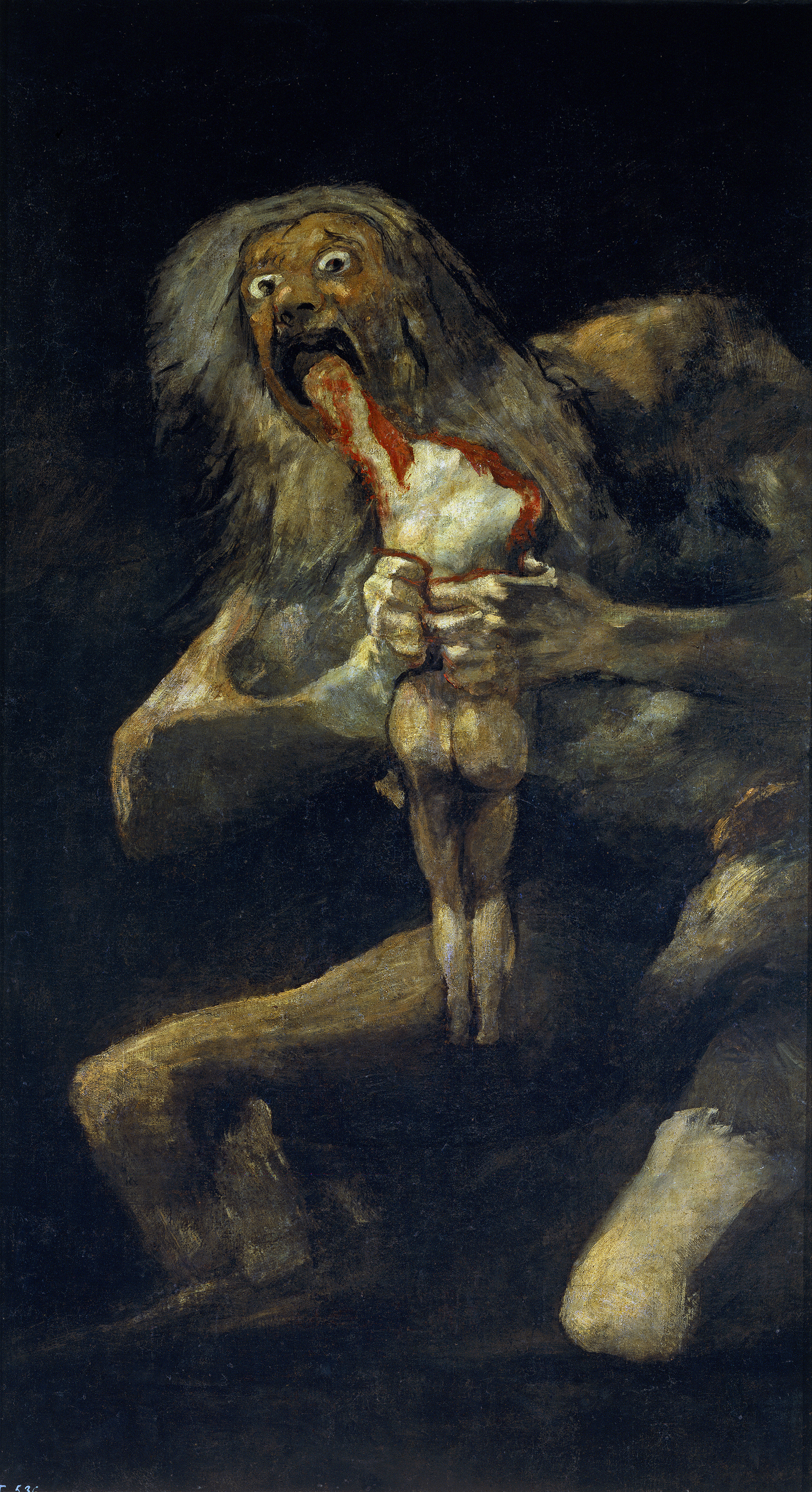
The first painting Sally mentions is Francisco de Goya’s “Saturn Devouring His Son.” This rather disturbing painting is part of de Goya’s series Black Paintings, which were found painted on the walls of de Goya’s home after his death. The series consists of 14 paintings, all of which are known for their disturbing subject matter and bleak perspective.
The next piece Sally mentions in the story is Woman Bitten by a Serpent, sculpted in 1847 by August Clésinger. Sally’s memory of seeing the sculpture at the Musée d’Orsay as a child is based on my own memory of seeing the sculpture when I was fourteen.


Sally names several other famous artworks as she muses on the intersection between artistic depictions of pain and the erotic. The next piece she talks about is Sir John Everett Millais’s painting of Ophelia. Critical reception was mixed when the painting was first exhibited at the Royal Academy in 1852, with some critics taking issue with the artist’s decision to set Ophelia’s death in a rural English landscape instead of somewhere more fittingly beautiful.

Certainly the oldest artwork Sally references in the story is the sculpture Laocoön and His Sons, which was excavated from Rome in 1506. Virgil’s Aeneid describes how the Trojan priest Laocoön and his teenage sons, Antiphantes and Thymbraeus, were strangled by sea serpents sent by goddess Minerva, who was enraged with Laocoön for advising the Trojans against bringing the Trojan horse into Troy and then throwing a spear at it when his advice was not heeded.

Sally’s final example of the strange overlap between the erotic and suffering is William-Adolphe Bouguereau’s 1850 painting Dante and Virgil, which is also on display at the Musée d’Orsay. Though clearly brutal in its violence, a well-circulated post featuring the painting on Tumblr is filled with users giggling at the work’s strangely homoerotic imagery.

In the depths of her obsession, Sally compares the expression on her print of St. George to the expression worn by Holofernes in Artemisia Gentileschi’s painting Judith Slaying Holofernes. Gentileschi actually painted the subject twice in her career. The image below is her second attempt and likely the one Sally had in mind when making the comparison. The painting’s depiction of Judith is speculated to be a self-portrait of Gentilieschi, a decision which may have been motivated by Gentileschi’s experience of being raped by a colleague of her father’s when she was seventeen. According to her own account at her rapist’s trial, Gentileschi brandished a knife at her attacker after he got off of her, saying, “I’d like to kill you with this knife because you have dishonored me.”

After musing for a moment, Sally concludes that the St. George in her print doesn’t really resemble Holofernes after all but instead evokes Teresa of Ávila’s rapturous expression in The Ecstasy of St. Teresa, sculpted by Gian Lorenzo Bernini between 1647-1652. The sculptured was based on Teresa of Ávila’s own account of the religious ecstasy she experienced during her encounter with an angel. The Wikipedia article on the sculpture includes the following excerpt from Teresa of Ávila’s autobiography, The Life of Teresa of Jesus. The sexual overtones of the text are hard to ignore.
“I saw in his hand a long spear of gold, and at the iron’s point there seemed to be a little fire. He appeared to me to be thrusting it at times into my heart, and to pierce my very entrails; when he drew it out, he seemed to draw them out also, and to leave me all on fire with a great love of God. The pain was so great, that it made me moan; and yet so surpassing was the sweetness of this excessive pain, that I could not wish to be rid of it. The soul is satisfied now with nothing less than God. The pain is not bodily, but spiritual; though the body has its share in it. It is a caressing of love so sweet which now takes place between the soul and God, that I pray God of His goodness to make him experience it who may think that I am lying.“

These are the individual pieces that Sally references by name. Tomorrow, I’ll make a post about other artistic influences on the story, including artistic depictions of St. George and the stylistic differences that Sally comes to prefer as the cursed print twists her mind.
I’ve always been fascinated by art, and this story gave me a great opportunity to to dust off my knowledge put it to use narratively.
~Brittany
 Brittany Taylor Barber